The short version
- No provider is cheapest everywhere. Fare competitiveness is route- and origin-specific.
- The cheapest seats usually come from low-cost carriers and NDC direct connections — both largely outside the traditional GDS.
- Most serious platforms run two or more sources and compare in real time.
- The only reliable test is running your own top routes through each provider and comparing.
Every flight API provider claims the best fares. They cannot all be right, and in an important sense none of them are — because fare competitiveness depends on the route, the point of sale, the carrier mix and the contracts behind the content. A provider that is excellent for Dubai to Kochi may be mediocre for Dubai to London.
This article explains the four content types, what each is genuinely good at, and how to evaluate providers on evidence rather than marketing.
The four sources of flight content
GDS: broad, reliable, increasingly incomplete
Amadeus, Sabre and Travelport aggregate published fares from most full-service carriers. Their strengths are genuine: enormous coverage of legacy airlines, mature handling of complex itineraries, multi-city routing, and well-established processes for changes and refunds.
Their weakness is what they no longer carry. Low-cost carriers largely never joined, and airlines increasingly hold their sharpest fares back for direct and NDC channels. A GDS-only platform in 2026 will look expensive on exactly the routes price-sensitive customers care about.
NDC: where airlines put their best fares
NDC lets airlines distribute directly with richer content — branded fares, seat selection, baggage, ancillaries — and frequently better pricing, because it costs the airline less and strengthens the direct relationship.
The practical difficulty is fragmentation: each airline implements it differently, so twenty carriers means twenty integrations. NDC aggregators solve this by normalising many airlines behind one API. If your customers compare prices, you need NDC exposure.
Low-cost carriers: the biggest lever in many markets
In the Gulf and South Asia, low-cost carriers frequently offer the cheapest available seat. They typically do not distribute through the GDS at all, so access comes through aggregators with direct LCC connections.
This is the single most common reason a platform looks uncompetitive. If your provider does not carry the low-cost carriers your customers actually fly, no amount of markup tuning will fix your prices.
Consolidators: net and private fares
Consolidators hold their own airline agreements and resell at net rates, often blending GDS, NDC, LCC and privately negotiated fares into a single API. They are usually strongest on their home routes, where their contracts are best.
For an independent agency, a consolidator is generally the most practical starting point: one API, one commercial relationship, no accreditation requirement, and content that is already blended.
Comparing the models
| GDS | NDC aggregator | Consolidator | LCC aggregator | |
|---|---|---|---|---|
| Coverage | Very broad, legacy carriers | Growing, varies by airline | Blended, strongest regionally | Low-cost carriers only |
| Price competitiveness | Moderate | Often best on covered carriers | Good on home routes | Best where LCCs fly |
| Onboarding | Slow; accreditation usually needed | Moderate | Fast | Moderate |
| Ancillaries | Limited | Rich | Varies | Essential — bags and seats are the revenue |
| Servicing | Mature | Improving | Via the consolidator | Often restrictive |
Where the cheap fares actually are
Three sources beat standard published fares, and they are worth naming explicitly.
Low-cost carrier content. On short and medium haul in the Gulf and Indian subcontinent, this is usually the cheapest option outright. Missing it is the most damaging gap.
NDC fares. Airlines routinely price NDC below their GDS equivalent, and add ancillary options that increase your revenue per booking.
Private and net fares. Consolidator-negotiated rates below published price, typically strongest on the consolidator’s core markets.
Notice that only one of these lives comfortably in the GDS. That is the structural reason a single traditional connection no longer produces competitive pricing.
How to actually test a provider
Ignore the brochure. Run this exercise instead, and it will tell you more than any sales call.
- List your ten most-booked routes. Real ones, with realistic dates — a mix of 2 weeks, 6 weeks and 3 months out.
- Search each route on every provider on the same day, within the same hour. Fares move; comparisons across days are worthless.
- Record the lowest total fare including taxes, and which carrier it is.
- Compare against a public reference — a major metasearch site — to see how far off market you are.
- Check the carrier mix. If low-cost carriers never appear, that provider is missing an entire content category.
- Test one booking end to end on the test environment, including cancellation, to see how servicing behaves.
Do this and you will usually find that no single provider wins across all ten routes — which is precisely the argument for connecting two.
Questions to ask before signing
- Which low-cost carriers do you carry, specifically? Name them.
- Which airlines do you have NDC connections with?
- Do you offer private or net fares, and on which markets?
- Is your content strongest from a particular point of sale?
- Can I cancel and refund by API, or does it require a support ticket?
- Are ancillaries — bags, seats — available through the API?
- What are the rate limits, and is caching allowed or forbidden?
- What is the deposit or credit arrangement, and which currency am I billed in?
- Will you onboard a company incorporated in my country? Ask explicitly.
That last question matters more than it sounds. Some providers only onboard companies from a defined list of jurisdictions, and the restriction is not always advertised until you reach the signup form. Confirm eligibility before you plan a roadmap around a provider.
Why multi-supplier is the real answer
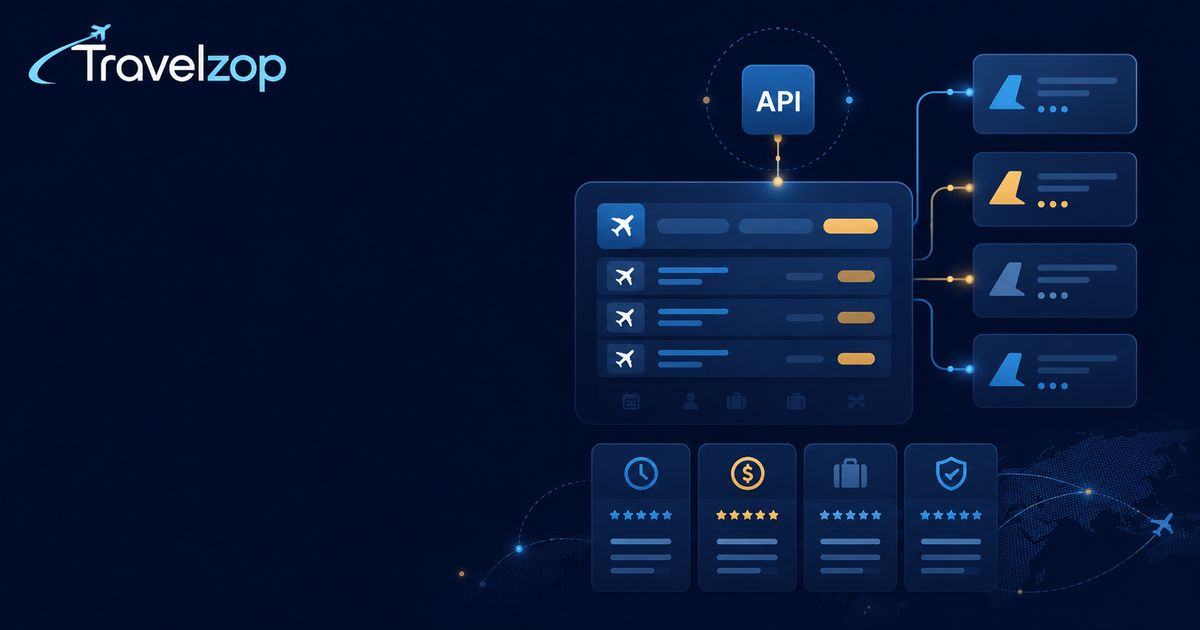
Once you accept that no provider wins everywhere, the architecture follows. Connect two or three sources, run every search across all of them in parallel, and present the cheapest confirmed result.
The benefits compound:
- Price: you show the best of several sources rather than one provider’s view.
- Coverage: routes one provider cannot serve are covered by another.
- Resilience: if a supplier has an outage or terminates, you keep trading.
- Leverage: commercial conversations go differently when you are not captive.
The requirement is that your platform treats suppliers as interchangeable adapters behind a common interface. Retrofitting that into a system built around one supplier is a rebuild; designing for it costs almost nothing at the start.
Practical recommendation
For a new agency in the Gulf or South Asia: start with a regional consolidator that carries the low-cost carriers your customers fly, because that combination covers most of your demand with one relationship. Add a second source — an NDC or LCC aggregator with different coverage — once you are live and can measure where you lose on price.
Then keep measuring. Run the ten-route comparison quarterly. Content and contracts change, and the provider that was cheapest last year may not be this year.
Ancillaries: the revenue most agencies leave behind
Airlines now earn a substantial share of their revenue from things that are not the seat — checked baggage, seat selection, priority boarding, meals, lounge access, flexible fare rules. On low-cost carriers this is not a side business; it is the business model, and the headline fare is deliberately stripped back.
For an agency this cuts two ways. If your platform cannot sell ancillaries, you show a bare fare and the customer buys the bag directly from the airline afterwards — you carry the acquisition cost and someone else takes the margin. Worse, your total price can look misleadingly cheap next to a competitor who bundles bags, and customers who discover the difference at the airport blame you.
Ancillary support varies enormously by content type. NDC connections generally expose the richest set. Direct low-cost carrier integrations usually support bags and seats because those are core to the fare. Traditional GDS content is the most limited. When comparing providers, ask specifically which ancillaries are available through the API, whether they can be sold at the time of booking, and whether they can be added post-booking — the last one matters because a meaningful share of customers decide on baggage later.
Servicing: what happens after the booking
Search and book is the demo. Servicing is the job. Before committing to a provider, establish exactly how each of these works, because the answers vary far more than the marketing suggests:
- Voluntary changes. Can the customer change dates through your platform, or does it require your staff to contact the supplier? What is the fare difference calculation, and who applies the airline change fee?
- Involuntary changes. When an airline reschedules or cancels, does the provider notify you by API or webhook, or do you find out when the customer calls? This is one of the single biggest operational differences between providers.
- Refunds. Can you initiate a refund by API, and how long until funds return to your account? Refunds that take ninety days materially affect your working capital.
- Void windows. Many tickets can be cancelled without penalty within a short period after issue. If your platform cannot void within that window, an easily-corrected mistake becomes an expensive one.
- Name corrections. Minor spelling errors are common. Some airlines permit free correction within a period; whether you can action it depends on your provider.
A provider with slightly higher fares but genuine API servicing is frequently the better commercial choice, because every manual intervention costs staff time that never appears in a price comparison.
Caching, rate limits and the cost of searching
Flight search is expensive to serve, so providers impose rate limits and have opinions about caching. These constraints shape what your platform can offer.
Some providers forbid caching outright, requiring every displayed price to be live. Others permit short-lived caching for browse-style experiences. If you want features like a flexible-date calendar or a “cheapest month” view, you need either generous limits or explicit permission to cache — otherwise you will exceed your quota within hours of launch.
Ask three questions: what is the searches-per-second limit, what happens when it is exceeded (throttling or errors), and is caching permitted and for how long. A provider whose limits force you to build a slower, less exploratory search experience is imposing a real product cost.
A short glossary
PNR — Passenger Name Record, the airline’s reservation reference. It is not the same as a ticket number; a booking can hold a PNR without being ticketed.
Ticketing time limit — the deadline by which a held booking must be ticketed or it cancels automatically. Missing these is a common source of lost bookings.
Fare basis — the code identifying the specific fare and its conditions, including change and refund rules.
Branded fare — a bundle such as Economy Basic or Economy Flex, packaging the seat with a defined set of ancillaries and rules.
Net fare — a rate below published price, negotiated by a consolidator, on which you add your own margin.
Void — cancelling a ticket within a short window after issue, usually without penalty. Distinct from a refund, which follows the fare rules.
Frequently asked questions
Which flight API has the cheapest fares?
There is no single answer, because fare competitiveness depends on the route, the point of sale and the carrier mix. The cheapest seat on a short regional route is often a low-cost carrier, which many providers do not carry at all. The reliable approach is to test your own top routes across several providers on the same day and compare.
What is the difference between GDS and NDC?
A GDS aggregates published fares from many airlines into one interface and has been the industry backbone for decades. NDC is an XML standard that lets airlines distribute directly with richer content and often lower fares. In practice, GDS gives breadth and mature servicing; NDC gives better pricing and ancillaries on the airlines that support it.
Do I need low-cost carrier content?
In most Gulf and South Asian markets, yes. Low-cost carriers frequently offer the cheapest available seat and generally do not distribute through the GDS. If your provider does not carry them, your prices will look uncompetitive on exactly the routes most price-sensitive customers search.
Can I connect more than one flight API?
Yes, and most competitive platforms do. Searches run across all connected sources in parallel and the cheapest confirmed result is shown. This requires an architecture where suppliers sit behind a common interface, so adding one is a contained piece of work rather than a rewrite.
How do flight APIs charge?
Booking APIs usually do not charge per search or per call. Providers make money on the margin between net and sell price, and typically require a prepaid deposit or credit line instead of a subscription. Metered per-request pricing is more common with flight data APIs, which provide status and schedule information but cannot be used to sell tickets.
See it working, not just described
Travelzop is a white-label travel platform built and run in the UAE — flights, hotels, tours, car hire and transfers, with your brand on it and the source code in your hands.
Talk to us →